
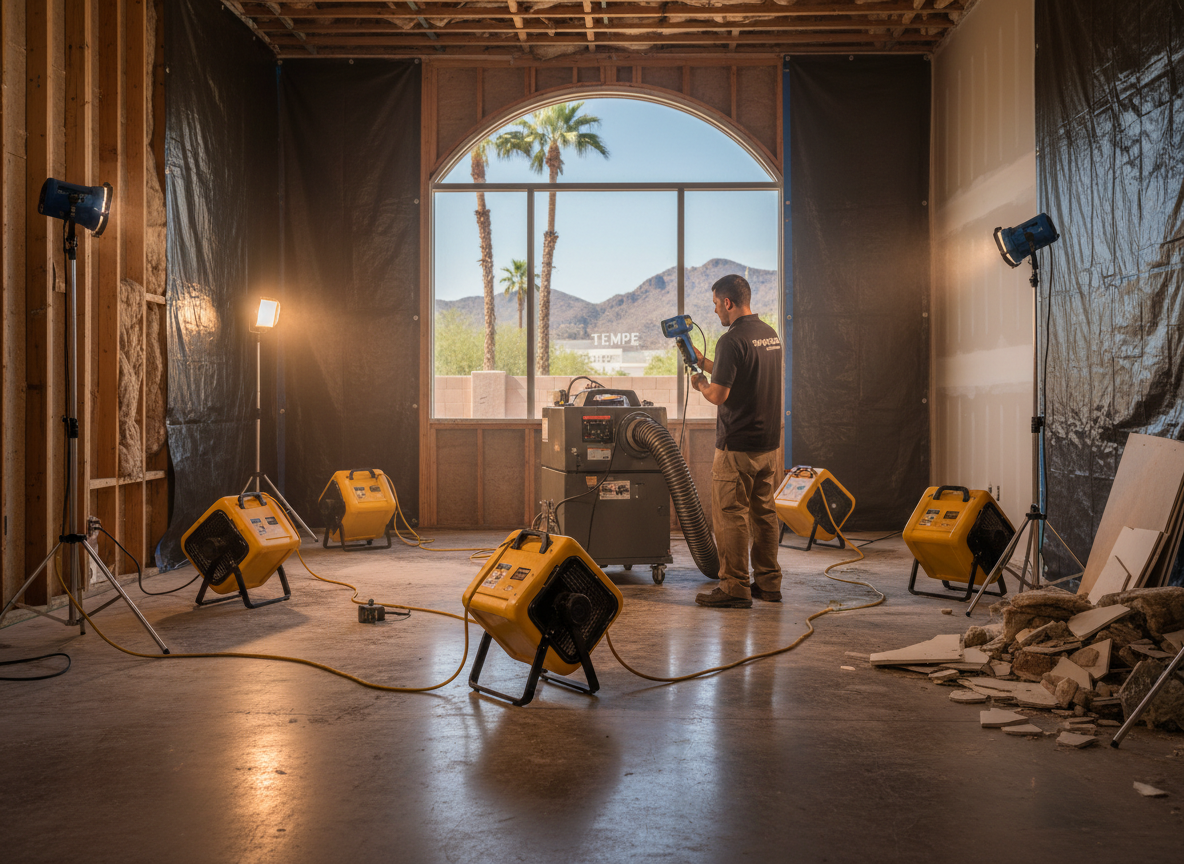
Tempe's hot desert climate drives fast surface drying that often leaves hidden moisture trapped in drywall, stucco, and concrete slabs common in South Tempe and Papago Park homes. Industrial dehumidifiers and air movers must run longer here than in milder climates because low humidity pulls moisture from deep within materials while high summer heat can push it back into the structure if equipment is removed too soon. We monitor moisture readings daily with penetrating meters to confirm levels return to normal before any reconstruction begins.
Flooding from monsoon runoff or Tempe Town Lake overflows frequently affects older housing stock near Mill Avenue and Arizona State University, where slab-on-grade construction and limited crawl spaces make complete drying difficult. Edge cases include saturated insulation behind tile in bathrooms and moisture migrating into neighboring units in multi-family buildings. We isolate affected zones with containment barriers to prevent cross-contamination and adjust equipment placement based on actual airflow patterns rather than standard layouts.
Maricopa County building practices often include stucco exteriors and minimal vapor barriers, so we routinely check exterior walls and window frames after any water event. Removing carpet padding and baseboards early allows air to reach the bottom plates; skipping this step leaves hidden mold risk even when surface readings look dry. Our crews document every reading and equipment setting so homeowners can see exactly when the structure is ready for repairs.
Technician insight
In Tempe, the thing that catches most people out with Structural Drying & Dehumidification is how quickly our low desert humidity makes surfaces feel dry while moisture stays trapped behind stucco and in slab edges common in South Tempe homes from the 1970s and 80s.
Hidden moisture after monsoon runoff
Water from heavy rain entered a South Tempe garage and wicked into the adjacent living room slab. We found elevated readings two feet up the drywall even after the homeowner had used a shop vac. We placed dehumidifiers and air movers for six days, removed baseboards for airflow, and confirmed all materials returned to normal before any drywall repair began.
Structural Drying & Dehumidification Services We Offer
✓Moisture Mapping and Assessment
We use penetrating and non-penetrating meters to locate hidden moisture in walls, floors, and ceilings throughout Tempe properties.
✓Industrial Dehumidifier Placement
High-capacity units sized for desert conditions pull moisture from saturated materials in Downtown Tempe and South Tempe homes.
✓Air Mover and Drying Equipment Setup
Directed airflow across wet surfaces speeds evaporation while preventing secondary damage to nearby drywall and cabinetry.
✓Daily Moisture Monitoring
Technicians return each day to record readings and adjust equipment until structures reach pre-loss moisture levels.
✓Containment and Air Filtration
Negative air machines and plastic barriers keep drying work isolated from unaffected areas in multi-unit buildings near ASU.
Structural Drying & Dehumidification Cost in Tempe, AZ
| Service | Typical Range | What Affects It |
|---|---|---|
| Single room drying package | $650–$1,200 | Depends on wall and floor saturation depth |
| Whole-home drying after flood | $1,800–$3,500 | Larger homes near Tempe Town Lake often require more equipment days |
| Daily equipment rental extension | $150–$300 per day | Added when monsoon humidity slows drying |
| Moisture mapping only | $250–$450 | Useful when damage is limited to one area |
Ranges are typical for Tempe, AZ and confirmed with an exact written quote before any work starts.
How it works
- 1
Initial Assessment
We arrive at the property, identify all affected materials, and set up containment to protect unaffected spaces.
- 2
Water Extraction
Standing water is removed first so drying equipment can focus on residual moisture in walls and floors.
- 3
Equipment Deployment
Dehumidifiers and air movers are positioned based on moisture readings and the home's construction type.
- 4
Ongoing Monitoring
Daily visits track progress until all materials test dry and are safe for reconstruction.
- 5
Final Verification
Final moisture readings are documented and equipment is removed once the structure meets dry standards.
Pricing
Pricing varies by affected square footage, number of rooms, and duration of equipment run time. Call during business hours for an on-site assessment.