
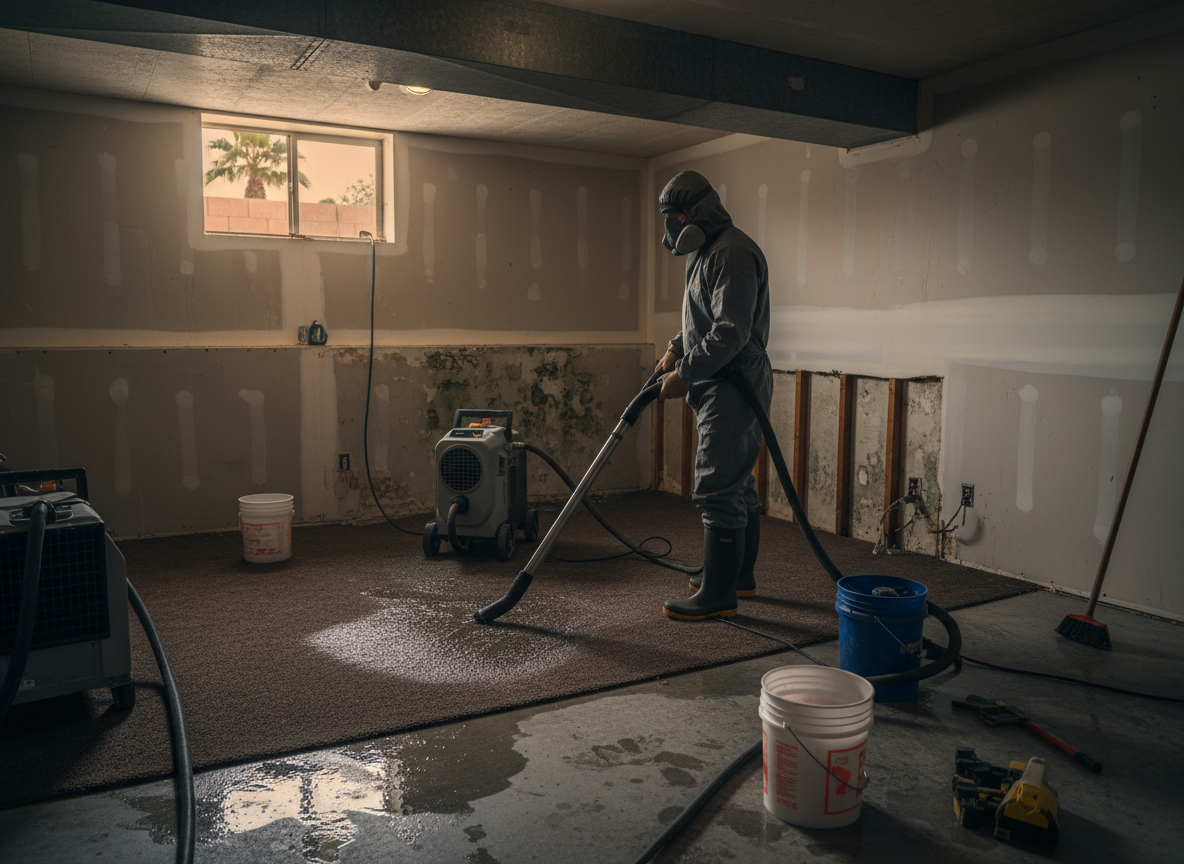
Tempe’s hot desert climate brings sudden monsoon downpours that overwhelm older drainage in South Tempe ranch houses and Papago Park bungalows built before modern grading standards. Water often enters through low window wells and carports rather than roofs, soaking slab foundations and traveling under drywall on the east side of structures where afternoon storms hit hardest. Restoration crews must pull baseboards early and use moisture meters on stucco walls because trapped water behind plaster can feed mold within 48 hours when daytime highs exceed 105 degrees.
Mill Avenue commercial buildings and Downtown Tempe apartments sit on compacted fill near Tempe Town Lake, so storm water can back up through floor drains and travel laterally into neighboring units. Technicians map utility lines before extraction because older Maricopa County properties frequently have shallow irrigation and electrical conduits that complicate negative-pressure drying setups. Skipping this step risks secondary damage to shared walls when high-velocity air movers are placed without proper containment.
After extraction, crews focus on hidden pockets in South Tempe crawl spaces where clay-heavy soil holds moisture against stem walls. Infrared scans locate damp joists that air alone will not dry before the next storm cycle. Homeowners who skip professional dehumidification often see cupping hardwood floors weeks later once mild winter temperatures slow evaporation.
Technician insight
In Tempe the thing that catches most people out with storm water damage restoration is how fast monsoon water travels under stucco on the east side of 1970s ranch houses in South Tempe once it hits the compacted fill around Papago Park. Homeowners think the slab is dry because the floor feels cool, but clay soil against the stem wall keeps feeding moisture upward for days after the rain stops.
South Tempe Ranch House After Monsoon
Storm water entered through a carport door and traveled under the slab into the living room. Extraction removed surface water the same afternoon, but infrared scans showed persistent moisture along the east foundation wall. Targeted drying equipment ran for four days until readings dropped below 12 percent, preventing mold growth before the next weather system moved through Maricopa County.
Storm Water Damage Restoration Services We Offer
✓Monsoon Runoff Extraction
Rapid removal of street and yard water that enters through doors and window wells during summer storms in South Tempe and Papago Park.
✓Tempe Town Lake Flood Containment
Temporary barriers and water diversion for properties near the lake and Mill Avenue where overflow reaches commercial and residential slabs.
✓Stucco Wall Drying After Storms
Targeted drying of exterior stucco and interior drywall in homes where monsoon rain is driven sideways by desert winds.
✓Crawl Space Dehumidification
Moisture removal from under older South Tempe homes where clay soil retains storm water against foundations for weeks.
✓Slab Leak Tracing Post-Storm
Detection and isolation of water that travels under concrete slabs from overwhelmed street drains in Downtown Tempe.
Storm Water Damage Restoration Cost in Tempe, AZ
| Service | Typical Range | What Affects It |
|---|---|---|
| Initial Extraction Visit | $350–$750 | Higher when water reaches multiple rooms or requires containment in shared walls |
| Equipment Rental Per Day | $150–$300 | Depends on number of air movers and dehumidifiers needed for slab and stucco drying |
| Crawl Space Drying Add-On | $400–$800 | Common in South Tempe homes where clay soil holds moisture against foundations |
Ranges are typical for Tempe, AZ and confirmed with an exact written quote before any work starts.
How it works
- 1
Arrival And Safety Assessment
Technicians arrive from the Baseline Road shop, shut off affected power, and walk the property to identify entry points common in Tempe’s older housing stock.
- 2
Water Extraction And Containment
Portable pumps and wands remove standing water while plastic barriers protect unaffected rooms in multi-unit buildings near Arizona State University.
- 3
Moisture Mapping And Drying
Infrared cameras and meters locate hidden moisture in stucco and slabs before industrial dehumidifiers and air movers begin the drying cycle.
- 4
Final Inspection And Documentation
Crew returns after 48–72 hours to verify dryness, remove equipment, and provide photos for insurance claims from Maricopa County properties.
Pricing
Pricing varies by water volume, access difficulty, and drying duration; most Tempe storm jobs fall into standard residential ranges.