
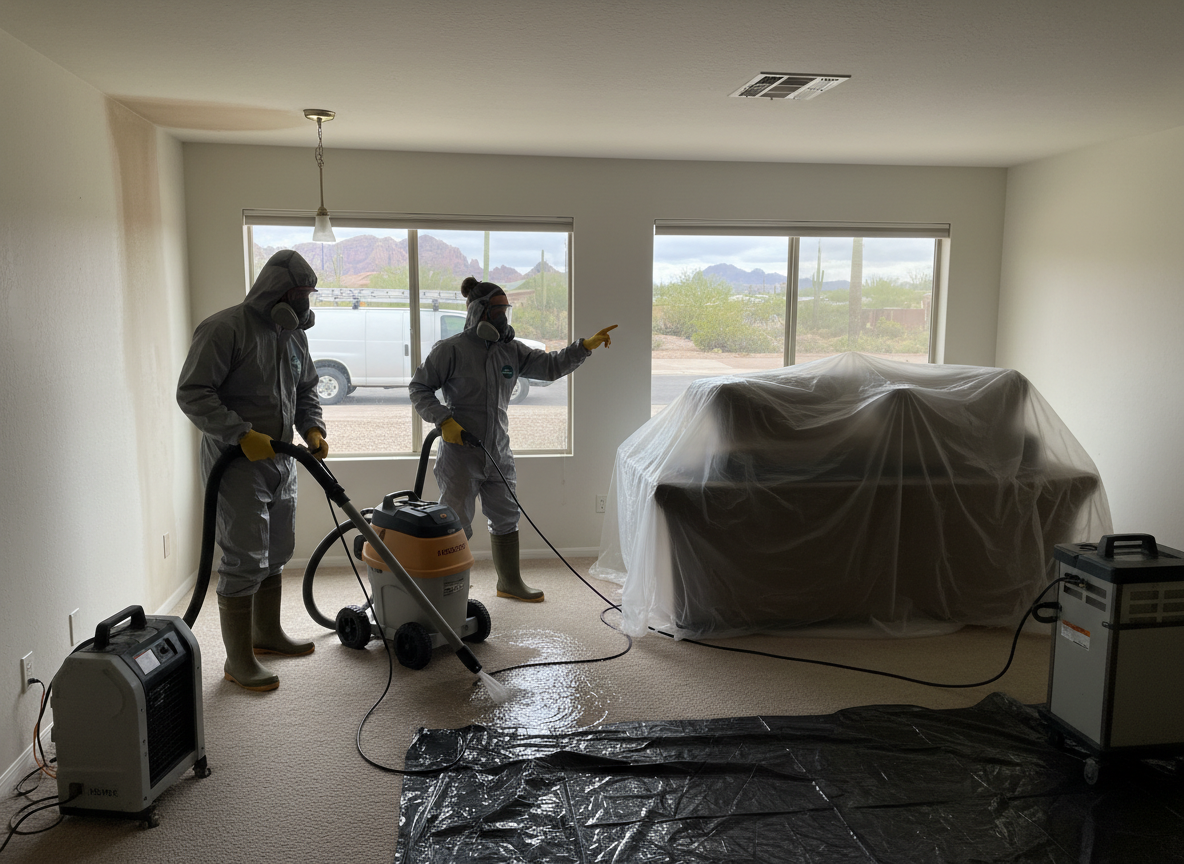
Tempe's hot desert climate brings intense monsoon storms that dump heavy rain in short bursts, often overwhelming drainage around older slab-on-grade homes in South Tempe and near Papago Park. These sudden inflows push water under baseboards and into drywall cavities faster than homeowners expect, especially in properties built before updated Maricopa County grading rules. Technicians must account for the low-permeability desert soil that keeps moisture trapped against foundations for days after the rain stops.
Homes close to Tempe Town Lake and along Mill Avenue frequently see groundwater seepage during prolonged wet periods, while Downtown Tempe apartments and mixed-use buildings can suffer from shared plumbing failures that affect multiple units. In these cases extraction alone is not enough; hidden pockets behind tile or under luxury vinyl plank require targeted moisture mapping to prevent secondary mold growth in the dry heat that follows. Crews familiar with Maricopa County building stock know to check HVAC returns and under-slab vapor barriers that older construction often lacks.
Nearby Phoenix, Mesa, and Chandler share the same aquifer and storm patterns, so jobs that start in Tempe sometimes extend across city lines when water migrates through connected utility trenches. Restoration plans must therefore include coordination with local permitting offices to confirm that any wall or floor repairs meet current Maricopa County floodplain requirements without adding unnecessary delays.
Technician insight
In Tempe the thing that catches most people out with Emergency Water Damage Restoration is how quickly monsoon water gets under the slab in pre-1980 South Tempe homes because the desert soil holds moisture against the foundation for days; skipping under-slab checks almost always leads to hidden mold weeks later.
Monsoon Flooding in South Tempe Residence
Heavy rain pushed water under the slab of a 1970s ranch near Baseline Road. Extraction removed surface water but moisture readings stayed elevated under tile. Targeted drying and slab-edge ventilation brought levels within range in five days without requiring floor removal.
Emergency Water Damage Restoration Services We Offer
✓Rapid Flood Extraction
High-volume pumps and truck-mounted extractors remove standing water from homes in South Tempe and Papago Park before it migrates into wall cavities or under slabs.
✓Structural Drying Services
Industrial air movers and dehumidifiers target moisture trapped in drywall, subfloors, and insulation common in Tempe's older ranch-style houses after monsoon events.
✓Contaminated Water Cleanup
Category 3 water from street flooding or backed-up sewers near Tempe Town Lake is removed with full PPE protocols and antimicrobial treatments to protect ASU-area rentals.
✓Emergency Board-Up and Tarping
Immediate securing of damaged windows, doors, and roofs on Mill Avenue commercial properties prevents additional rain intrusion during ongoing storm cycles.
✓Moisture Mapping and Documentation
Thermal imaging and pin meters locate hidden water behind tile and under cabinets in Downtown Tempe condos so repairs address every affected area.
Emergency Water Damage Restoration Cost in Tempe, AZ
| Service | Typical Range | What Affects It |
|---|---|---|
| Initial Assessment | Free | Includes moisture mapping for homes in Tempe 85283 and adjacent neighborhoods |
| Water Extraction | $600–$1,800 | Varies by volume and whether Category 3 water is involved near Tempe Town Lake |
| Equipment Drying (per day) | $250–$450 | Number of days required rises after heavy monsoon events in South Tempe |
| Antimicrobial Treatment | $300–$700 | Applied when contaminated water affects older slab homes common in Papago Park |
Ranges are typical for Tempe, AZ and confirmed with an exact written quote before any work starts.
How it works
- 1
On-Site Assessment
Technician arrives within the service window, documents all affected materials, and checks for hidden moisture paths typical in Tempe slab homes.
- 2
Water Removal
Standing water is extracted using equipment sized for the volume found in monsoon-related flooding around Papago Park and South Tempe.
- 3
Drying And Monitoring
Daily moisture readings guide placement of drying equipment until levels return to normal for Maricopa County desert conditions.
- 4
Final Clearance
All materials are rechecked and the site is released only after independent verification that no elevated moisture remains.
Pricing
Upfront written quotes provided after inspection; final cost depends on water category, affected square footage, and drying duration required by local climate.